01 · Evicourse Technology
Evicourse Intelligence Engine
Building reusable infrastructure for turning fragmented information into structured, traceable, and useful intelligence.
- Classification
- Evicourse Technology
- Discipline
- Reusable Intelligence Infrastructure
02 · The Challenge
What needed to work better.
Business information often exists across documents, records, analytical systems, and disconnected sources without a consistent structure.
Without extraction, normalization, validation, and traceability, interpretation becomes difficult to verify and reuse across products or operational workflows.
The system needed to preserve a path from source information to structured evidence and any later explanation or action.
That led to a reusable architecture: normalize inputs into canonical records, connect evidence to source and context, qualify what it supports, and expose it to applications through governed retrieval and interpretation.
System requirements
- Inputs use different structures and terminology
- Evidence can lose its source or context
- Validation requirements differ by domain
- Interpretation needs governed boundaries
- Useful information must remain searchable and retrievable
03 · The Solution
A system designed around the evidence.
Evicourse System Diagram · Information Processing Architecture
From information to evidence-backed understanding
A governed process for turning source information into structured, traceable findings.
Input
Information enters the system
Documents, website content, structured records, or other supported information sources.
System boundary
Evicourse Intelligence Engine
- 02
Extract & organize
Identify relevant information and create consistent records.
- 03
Validate & trace
Check information and preserve its source.
- 04
Store & retrieve
Make structured information available for relevant queries.
- 05
Interpret evidence
Generate bounded findings using available evidence.
Evidence traceability Validation Defined interpretation boundaries
Output
Structured, evidence-backed results
Validated records, source references, findings, and context that supported applications can use.
Extraction
Identify useful information from supported records and inputs.
Canonical records
Normalize different inputs into consistent structures.
Validation
Check required structure, quality, and qualification rules.
Provenance
Retain source, context, time, and domain relationships.
Classification
Organize evidence so applications can work with it consistently.
Governed interpretation
Use deterministic analysis and selective AI reasoning within evidence boundaries.
Search & retrieval
Make structured evidence available to products and workflows.
04 · Behind the System
Technology with a defined responsibility.
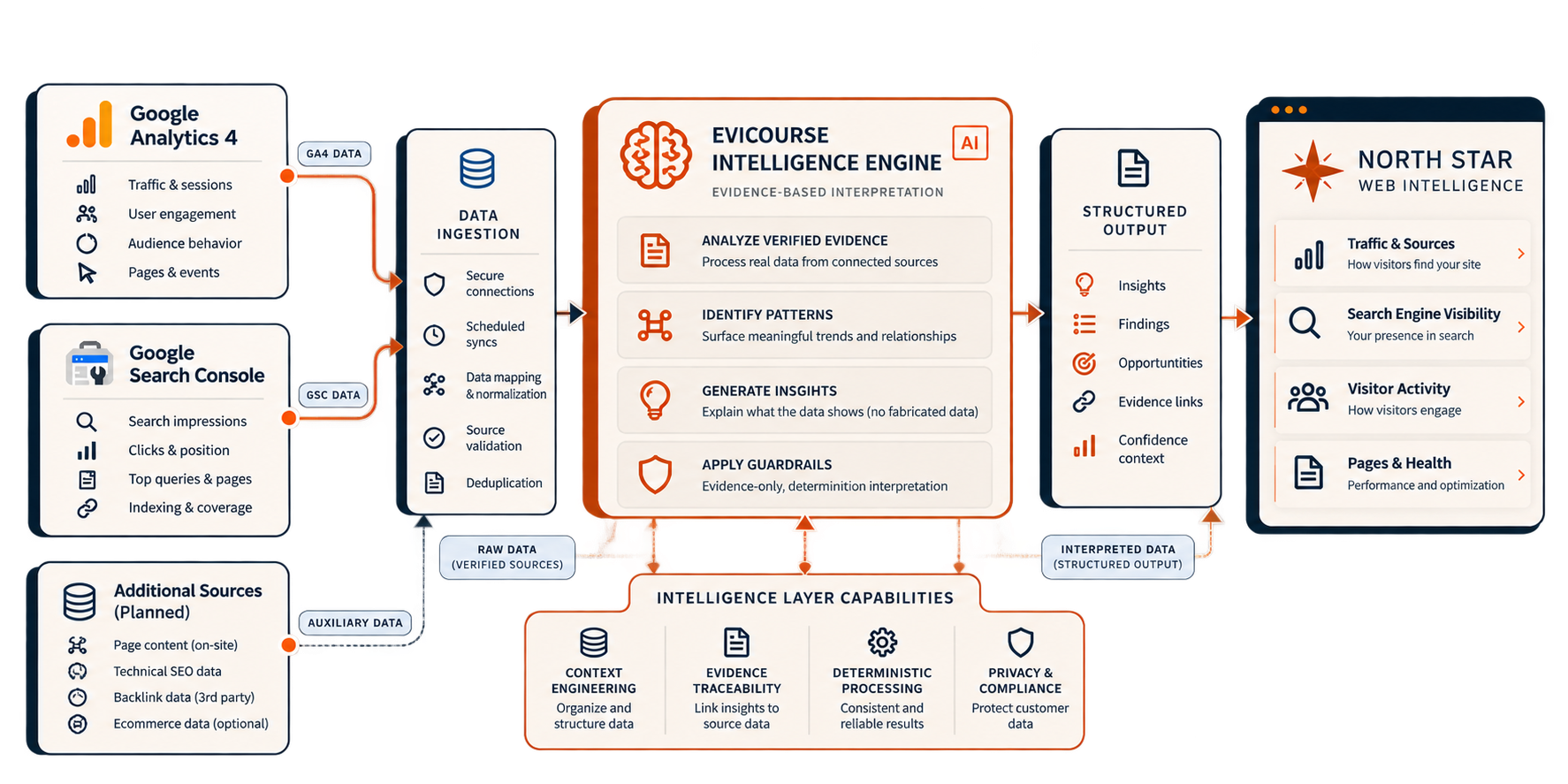
The Evicourse Intelligence Engine is reusable infrastructure beneath applications such as North Star.
I designed it to organize evidence before interpretation so products and workflows can explain what information supports, preserve its source, and use AI selectively rather than treating a model as the source of truth.
Structured records
Different inputs are normalized before they are interpreted.
Validation + provenance
Evidence retains quality checks, source, context, time, and domain relationships.
Classification
Consistent organization makes evidence usable by products and workflows.
Governed interpretation
Deterministic analysis and selective AI reasoning have distinct responsibilities.
05 · Implementation
Evidence of the work.
The implemented architecture structures data into canonical records and evidence nodes, connects that evidence to domain, source, context, and time, and prepares it for governed interpretation.
North Star provides the clearest current application: analytics and search evidence pass through the engine so findings can remain connected to what supports them. Other domain applications remain architectural possibilities rather than claimed shipped integrations.
Evicourse System Diagram · Processing Flow
How the Engine Processes Information
A continuous process that transforms source information into structured results for connected applications.
- 01
Receive
Information enters from a supported source.
- 02
Extract
Relevant content and data are identified.
- 03
Structure
Information is organized into consistent records.
- 04
Validate
Records are checked and linked to their sources.
- 05
Retrieve & interpret
Relevant evidence is used to produce bounded findings.
- 06
Deliver
Structured results become available to consuming applications.
Throughout the process
Source traceability, evidence boundaries, and controlled interpretation.
06 · Outcomes & Learnings
What the work establishes.
Core structuring, evidence relationships, qualification, and governed-interpretation patterns are implemented. The reusable engine and its application surface continue to evolve.
- Evidence can retain source and contextual relationships.
- Canonical structures create a reusable foundation across applications.
- Validation and governance occur before interpretive output.
- Deterministic analysis and AI-assisted reasoning have distinct responsibilities.
- North Star demonstrates the architecture in a working product context.
- Additional domain applications remain future work.